In a Volatile World, Your Business Doesn’t have to be a Casualty
Updated: 2026-05-21
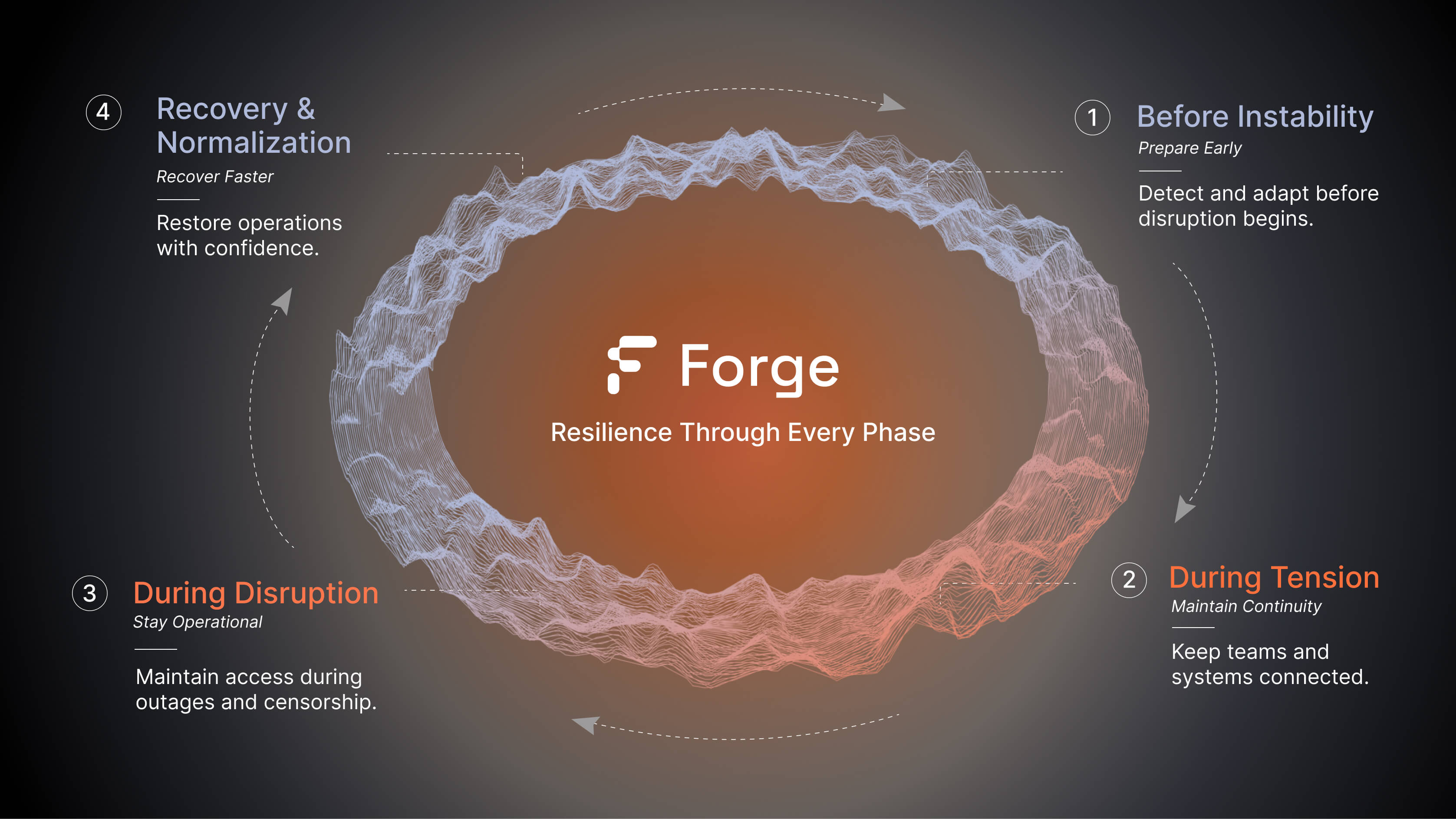
For organizations operating across borders, geopolitical instability is no longer an exceptional event; it’s becoming part of the operating environment. Data from ACLED, UNHCR, and the International Institute for Strategic Studies all point in the same direction: conflict exposure, displacement, political violence, and civilian impact are increasing globally. ACLED reports that nearly one in six people worldwide are now exposed to conflict conditions, while incidents of violence against civilians have reached the highest levels observed in years. The consequences are visible across the Middle East, Eurasia, Africa, and increasingly Southeast Asia. From regional wars and insurgencies to state-imposed shutdowns, infrastructure disruption, and communications restrictions, volatility is affecting not only governments and populations—but also businesses, platforms, and transnational organizations that depend on stable connectivity.
Targeting Connectivity Is Now Part of the Conflict Lifecycle: Modern conflict rarely emerges all at once. It evolves through stages: political tension, protests, network throttling, censorship, localized shutdowns, infrastructure degradation, and potentially active conflict. Throughout that lifecycle, communications networks are often among the first systems affected. Organizations operating across adjacent countries or regions increasingly face environments in which cloud services become intermittently unavailable, messaging and collaboration platforms are throttled, routing instability impacts operations, local filtering disrupts applications and APIs, and network conditions change dynamically and unpredictably.
The Internet Is Fragmenting: Traditional infrastructure was built around assumptions of stability. But today’s fragmented internet environment demands something different: resilience designed directly into applications and services themselves. The global internet is steadily evolving away from a unified network toward a collection of increasingly controlled digital “islands,” shaped by national regulation, digital sovereignty, regional conflict, and local political priorities. This fragmentation affects every transnational organization—whether in logistics, SaaS, finance, media, communications, IoT, or critical infrastructure. Services that work seamlessly in one region may degrade or fail entirely in another, often with little warning. Organizations can no longer assume consistent global reach simply because they are cloud-based. The operational challenge is becoming clear: how do you maintain continuity across a dynamically shifting internet landscape?
Forge as an Additional Resilience Layer: Psiphon Forge was designed specifically for this emerging reality. Rather than replacing existing infrastructure, Forge acts as an additional resilience layer embedded directly into applications, services, and platforms. It enables adaptive, multi-protocol connectivity that continues functioning across unstable, degraded, censored, or contested networks. This matters not only during active conflict, but across the entire volatility lifecycle—before instability escalates, during periods of heightened tension, through network disruption and censorship, and during recovery and normalization. Organizations that maintain continuity through these phases gain a significant operational advantage. Communication remains available. Data continues to flow. Services remain reachable. Customers and partners retain trust precisely when reliability matters most.
Resilience Is Strategic: As conflict volatility rises globally, resilient connectivity is shifting from a technical enhancement to a strategic business capability. Organizations that prepare early will be better positioned to operate consistently across uncertain environments, while those relying solely on conventional infrastructure risk becoming casualties of fragmentation, disruption, and instability. In a world where conditions can shift from conflict-free to active conflict rapidly, resilience can no longer be treated as optional redundancy. It is becoming a core requirement for transnational operations.